Buy-side M&A advisory for private equity

Buy-side advisory for platform and add-on acquisitions.

SilverShore Partners works beside a firm's existing sourcing, adding criteria-matched coverage across off-market, pre-market, and on-market opportunities, with initial diligence and operating support built in.

Investor services

What we do for private equity firms

Six services across four capabilities: deal origination, deal intelligence, diligence and transaction support, and portfolio and operating support. Start with what the mandate needs, or combine them.

Hand-drawn illustration of buyer mapping and criteria-fit deal sourcing

Deal sourcing

01 · Deal origination

We source off-market, pre-market, and on-market opportunities through our intermediary network, screening for alignment with your investment thesis before the first look.

What this includes
  • We source through the intermediary channels your firm already uses, while adding qualified coverage.
  • We screen for sector, geography, revenue, EBITDA, ownership, and transaction fit.
  • We source platform acquisitions and add-on opportunities against the right criteria.
  • We organize source context and open questions for a faster initial diligence pass.

Hand-drawn illustration of market intelligence, sector mapping, and a compass

Market intelligence

02 · Deal intelligence

We sharpen a thesis into a concrete target list built through relationship-led research.

What this includes
  • We map markets and conduct focused sector research.
  • We identify intermediaries whose mandates align with the thesis.
  • We build tailored lead lists of business owners operating in the buy box for proprietary outreach.
  • We turn the map into a prioritized origination plan.
Hand-drawn illustration of financial analysis ledgers and quality-of-earnings review

Financial diligence

03 · Diligence and transactions

We turn the data room into a clear investment picture while keeping every metric distinct and source-bound.

What this includes
  • We provide quality-of-earnings and financial review support.
  • We make revenue, margin, working capital, and cash conversion visible.
  • We organize the diligence checklist and decision-ready financial context.
  • We report annual EBITDA separately from SDE, cash flow, and revenue.
Hand-drawn illustration of portfolio monitoring, diligence automation, and dashboards

Portfolio company monitoring

04 · Operating support

We give sponsors a clear view of pipeline, growth activity, and the operating signals that matter across portfolio companies.

What this includes
  • We give the sponsor a clear view of pipeline and growth activity.
  • We organize key updates and movement into a consistent monitoring view.
  • We make follow-up, status, and next actions easier to review.
  • We can source add-on opportunities when a portfolio company has a defined acquisition lane.
Hand-drawn illustration of portfolio company consulting, value creation, and operating systems

Portfolio company consulting

04 · Operating support

We help service-based and other portfolio companies become more tech-enabled through automation consulting, custom software, and practical AI training.

What this includes
  • We map workflows and identify practical automation opportunities.
  • We develop custom software, dashboards, integrations, and internal tools.
  • We run AI workshops and build repeatable AI use programs for portfolio teams.
  • We train employees to use custom workflows, software, dashboards, and integrations productively.
Hand-drawn illustration of an investor website and credibility system

Investor credibility

04 · Operating support

We make the firm easier for founders, intermediaries, and capital partners to understand and trust.

What this includes
  • We develop investor and sponsor websites.
  • We clarify brand positioning and messaging.
  • We build proof, case-study, and portfolio presentation systems.
  • We create materials that make the firm legible to founders, intermediaries, and capital partners.
Who this is for

Built for private equity firms first

Private equity firms come first. We consider other qualified buyers only when their mandate and capital readiness fit the opportunity. Across both, the focus is durable businesses where better operating visibility and diligence-ready evidence can support the next stage.

Primary relationship

Private equity firms

  • We source thesis-matched platform and add-on opportunities.
  • We provide financial diligence support and operating context before a decision.
  • We support custom software builds, workflow consulting, team training, and growth initiatives after close.
Other qualified buyers

Selectively supported

We review family offices, independent sponsors, strategic acquirers, and search funds when their mandate and capital readiness fit the criteria.

Investment criteria

The deals we support

One size range across ten target sectors. These are hard sourcing gates: we do not source outside them.

Deal size

Annual EBITDA
$750K to below $25M
Gross annual revenue
$5M to $150M

Annual EBITDA is kept distinct from SDE, cash flow, and revenue. It is never derived from revenue or inferred from a margin.

Ten target sectors

  • Business services
  • Construction and contracting
  • Technology, software and digital
  • Consumer and home services
  • Healthcare
  • Transportation and logistics
  • Distribution and wholesale
  • Manufacturing
  • Building products and materials
  • Financial services

What qualifies

  • Companies inside the annual EBITDA and revenue ranges.
  • Durable, largely non-discretionary demand.
  • Operations that are documented, or can be documented for diligence.
  • Clear room to add growth and operating infrastructure.
  • A counterparty who genuinely wants a transition.

What we pass on

  • Below $750,000 in annual EBITDA or $5 million in gross annual revenue.
  • At or above $25 million in annual EBITDA, or above $150 million in gross annual revenue.
  • Undisclosed annual EBITDA, which cannot be published.
  • Pre-revenue or turnaround-only situations.
  • Dependence on a single customer or on one principal alone.
  • No realistic path to operating improvement.
  • Already fully banked with no fit for our model.

Why undisclosed EBITDA is not published. SilverShore lists an opportunity publicly only when its annual EBITDA is source-disclosed. Without that evidence a profile stays private and criteria-matched, so the public library shows only profiles that already meet the publication standard.

How a mandate runs

From mandate to investment decision

This is a criteria-fit process rather than a spray of teasers. Each handoff protects counterparty relationships and your team's time.

Mandate

Set the criteria

We document your thesis, size, geography, structure, and the operating profile you can improve.

Map

Build the target universe

We use sector mapping and research to turn the thesis into a concrete target universe.

Match

Review qualified opportunities

We gate opportunities against your criteria and introduce them blind, without confidential source detail.

Prepare

Give diligence a clean starting point

We assemble operating and financial context so the first review is substantive.

Decide

Choose whether to proceed

Your team decides whether to proceed, and nothing is shared with the owner until you opt in.

Where most mandates start

Start with the market. Then expand the pipeline.

Market intelligence and deal sourcing are the front door. We make the thesis clearer, then add qualified coverage around the deal flow systems your firm already runs. Each map can show thesis-matched opportunities, intermediaries aligned with the mandate, and tailored owner lead lists for proprietary outreach.

A six-step sourcing process

From thesis to qualified targets

  1. 1
    Define the mandate

    Translate the investment thesis into sectors, sub-sectors, size, EBITDA, revenue, ownership, and geography.

  2. 2
    Map the landscape

    Show relevant state coverage, market structure, buyer universe, and intermediary routes.

  3. 3
    Match aligned intermediaries

    Identify intermediaries whose mandates and relationships align with the investor's thesis.

  4. 4
    Build target lists

    Build thesis-matched opportunities and tailored business-owner leads for proprietary outreach.

  5. 5
    Classify platform and add-on lanes

    Separate platform criteria from add-on criteria, including portfolio company acquisition needs.

  6. 6
    Move qualified targets forward

    Turn the map into a prioritized origination plan with evidence, next actions, and decision context.

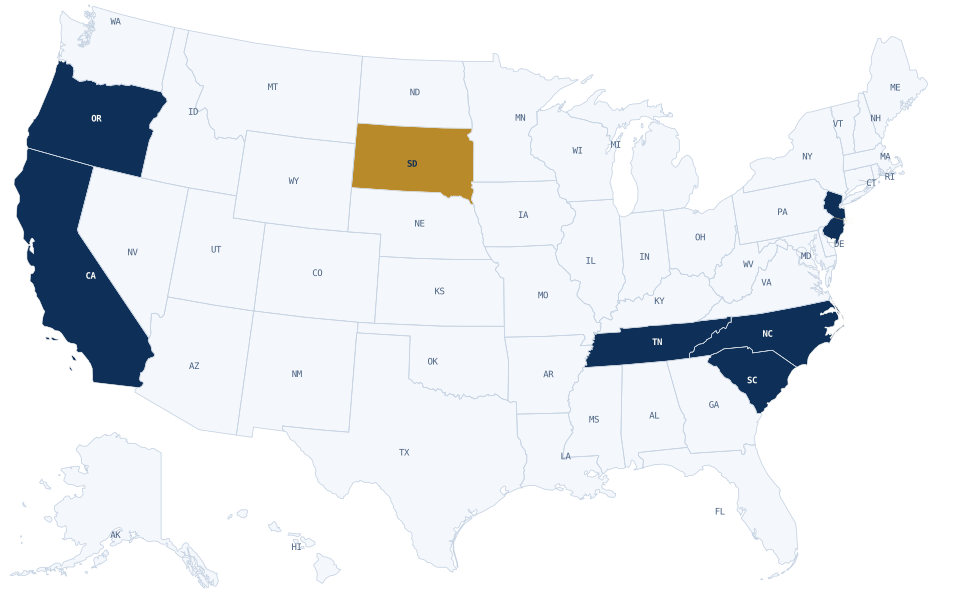
United States outline with two-letter state initials and selected illustrative market coverage states
Illustrative market map layer. State initials show the geography a commercial map can organize. Live opportunity density, aligned intermediary routes, and owner lead coverage are populated from the mandate and source set.
State key

Overview labels stay abbreviated for legibility. The selected example states are expanded here.

CA CaliforniaCO ColoradoFL FloridaGA GeorgiaIL IllinoisNC North CarolinaNY New YorkPA PennsylvaniaTX TexasWA Washington
How the map becomes useful

One market map, three decision views

The examples below show the kind of commercial output a map can produce for thesis alignment. They are illustrative formats, not current inventory.

Illustrative output
Coverage

Opportunity count by state

A quick view of where opportunity, intermediary, and owner coverage has enough density to support a focused origination lane.

CA9
TX7
FL5
NY4
GA3
Size bands

Size and EBITDA signal

The map can separate platform candidates from smaller add-ons without collapsing revenue and EBITDA into one proxy.

PlatformSized to the buyer's platform criteria
Add-onSized to add on to an existing platform
WatchSource needs further financial enrichment
Role in the thesis

Platform, add-on, or resource

A final layer tells the deal team what each opportunity is meant to do in the acquisition strategy.

PPlatformAnchors a new geography or thesis
AAdd-onExtends an existing portfolio company
RResourceShows an intermediary or referral path
Initial diligence

Make the first diligence pass easier to complete

The objective is not to add more process. It is to qualify fit earlier, organize the evidence, and give Investment Committee a clear next decision. When the first pass moves faster, the strongest opportunities can advance toward a close with less rework.

Thesis-fit screen

Pre-qualification before the first call

We compare each opportunity against the firm's registered thesis and record the fit, gaps, and follow-up questions.

Initial diligence

Organize the evidence that matters first

We normalize disclosed metrics, connect source context, and group the financial and operating questions that need answers.

Committee handoff

Give the committee a clear decision path

Investment Committee sees what fits, what remains open, and whether the opportunity is ready to advance into deeper diligence.

The SilverShore Network

The network around the mandate

The SilverShore Network adds off-market, pre-market, and on-market deal flow from our intermediary network around the sourcing systems your firm already runs. Existing channels stay in place.

Publication standard

Public profiles require display permission and retain the source's original financial labels. Private opportunities remain blind-first and criteria-matched.

What criteria-matched coverage includes
ItemDetail
Thesis matchEach opportunity is gated to your criteria.
Mandate coverageRelevant opportunities aligned with your current acquisition mandate.
Market mapsSource-aware market context that shows where fit is emerging.
Opportunity updatesNotification when an opportunity fits the criteria you share.
Intermediary networkAccess to opportunities from our intermediary network and qualified mandates.
First lookYou receive a blind profile before any name.
Operating contextEach profile includes the available operating context.
ConfidentialitySource identity stays sealed until both sides opt in.
Answers

Questions from buyers

Are there live deals listed on the site?+
Public profiles distinguish authorized opportunities, public-market intelligence and potential acquisition targets. Each profile requires appropriate display permission. Private opportunities are routed against your mandate with source relationships protected.
How does SilverShore prepare opportunities for initial diligence?+
We screen opportunities against the firm's registered investment thesis before sharing them with the deal team. We organize disclosed financial metrics, source context, and open questions so the team can complete the first diligence pass faster and decide which opportunities should move to Investment Committee.
How are fit and confidentiality handled?+
Opportunities are gated against the thesis you share before any introduction. Company identity and confidential detail are withheld until both sides opt in.
Do you represent the buyer or the seller side?+
SilverShore's M&A work is buy-side focused: we work with buyers to find, evaluate, and advance acquisitions. SilverShore does not charge the seller or intermediary for buyer origination. Buyer commercial terms, where applicable, are governed by executed engagement documents. In qualifying private-company transactions we may operate within the federal M&A broker exemption; we are not a registered broker-dealer or investment adviser.
What is the SilverShore buy box?+
SilverShore screens for companies with annual EBITDA from $750,000 to below $25 million and gross annual revenue from $5 million to $150 million, across ten target sectors: business services; construction and contracting; technology, software and digital; consumer and home services; healthcare; transportation and logistics; distribution and wholesale; manufacturing; building products and materials; and financial services. SilverShore does not source outside those ranges. Annual EBITDA is kept distinct from SDE, cash flow, and revenue.
Why do undisclosed-EBITDA businesses not appear publicly?+
SilverShore publishes an opportunity only when its annual EBITDA is source-disclosed. Until that evidence exists the profile stays private and criteria-matched rather than published.
Start with your buy box

Share your acquisition criteria.

Share what your firm is looking to acquire. No subscription is required. We will assess fit first and agree commercial terms before any paid engagement or introduction.

A clear next step
  1. 01
    Share your firm and acquisition focus
  2. 02
    We review fit against current coverage
  3. 03
    Agree terms before paid work or an introduction