

Two things are true right now, and they do not fit together.
Investors are holding more money than they can put to work. More business owners are trying to retire and cash out than at any point in history.
You would think those two facts would create the busiest market for businesses we have ever seen. Buyers with cash. Sellers who want out. A handshake in the middle.
That is not what is happening. The deals are not getting done. Once you see why, you cannot unsee it. And if you will ever sell the business you built, it is worth understanding now, not the week you decide to list.
The Sellers Have Never Been More Ready
Start with the people trying to get out.
According to Pew Research Center, roughly 10,000 baby boomers began turning 65 every day as that generation reached retirement age. Project Equity, a nonprofit focused on ownership transitions, says more than half of all privately held U.S. businesses with employees have owners over age 55.
Sit with that for a second. Over half. The owners of the companies on your street, the HVAC shop, the machine shop, the accounting practice, the landscaping crew, are mostly old enough to retire, and many of them want to.
For almost every one of them, the business is the retirement plan. Not a 401(k). Not a pension. The company itself, sold for what it is worth, is the money they are supposed to live on for the rest of their lives.
That plan has exactly one requirement. Somebody has to buy it.
The Buyers Have Never Had More Money
Now look across the table.
The buyers are not missing. They are sitting on cash they cannot spend fast enough. EdgePoint Capital's 2026 outlook puts committed but undeployed private equity and family office capital at more than $2.5 trillion globally, including roughly $1.0 trillion in the U.S.
Bain & Company's 2026 private equity report shows the other side of the pressure: exit value rebounded in 2025, but the total number of exits declined, leaving firms under pressure to return capital and create value in a more selective market.
So the people with the money are under real pressure to move it. Sitting on cash is not a strategy for them. It is a problem they get paid to solve.
Record sellers who need to sell. Record buyers who need to buy. Every ingredient for a feeding frenzy.
So Where Are The Deals?
This is where it falls apart.
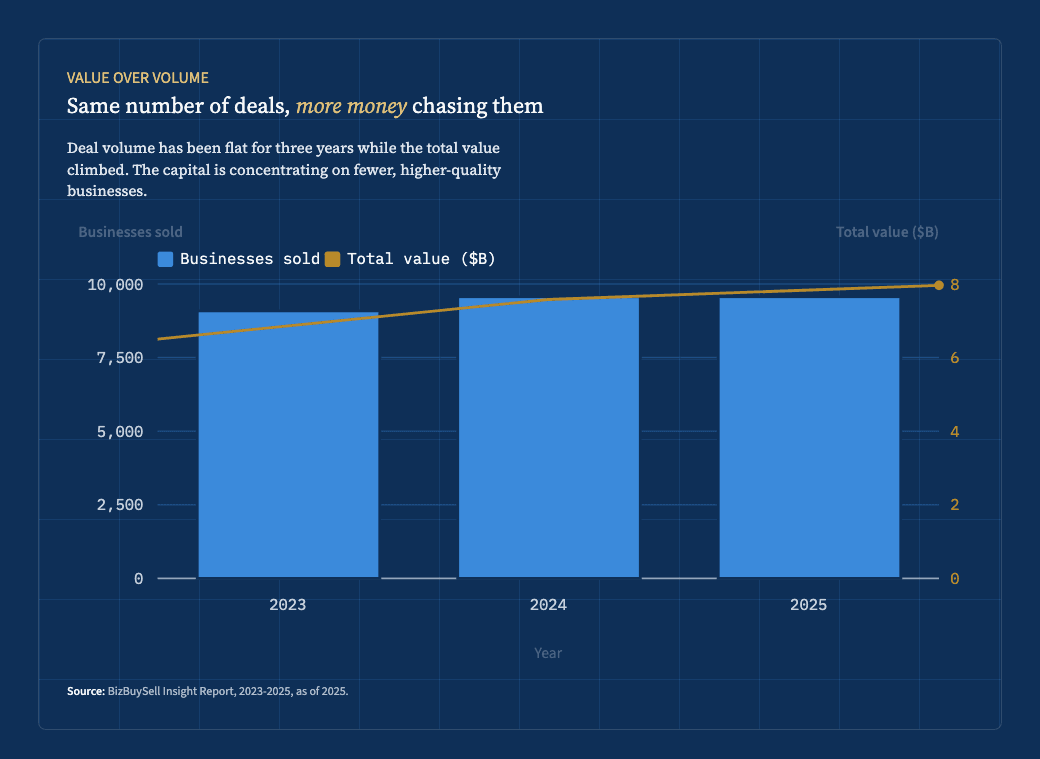
The number of businesses that actually change hands has barely moved. BizBuySell recorded 9,093 business sales in 2023, 9,546 in 2024, and 9,586 in 2025. In Q1 2026, closed transactions declined 1% from the prior year.
Three years. Record demand on one side, record supply on the other, and the line just sits there, flat.
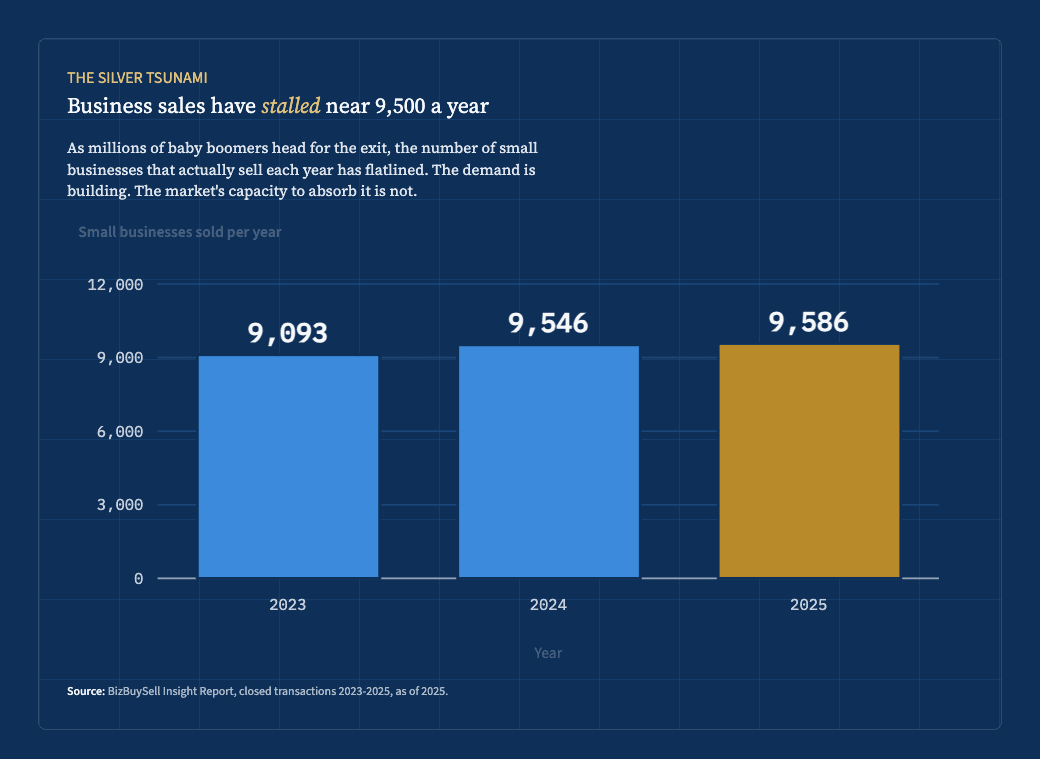
The wave of owners who want to sell keeps growing. The number who actually pull it off does not. Project Equity says many retiring owners are finding it hard to find a buyer when they are ready, and some of those companies quietly close down.
That is the paradox. Two oceans of supply and demand, with a wall between them that almost nobody is talking about.
It Is Not Really About Interest Rates
The easy answer is interest rates, and sure, they matter. When borrowing got expensive, the math on every deal changed. Sellers still wanted 2021 prices. Buyers paying more for their debt would not pay them. The two sides stopped agreeing, and plenty of deals froze right there.
Financing got tighter in other ways too. As of March 1, 2026, SBA 7(a) and CDC/504 guidance requires 100% of all direct and indirect owners of a small business applicant to be U.S. citizens or U.S. nationals with principal residence in the U.S., its territories, or possessions. Legal permanent residents are not eligible to own any percentage interest in an applicant under that notice. That quietly pushed a slice of buyers out, since SBA financing is how many small-business deals get done.
All of that is real. None of it explains why trillions in cash still cannot find a home. Money this motivated finds a way around a few points of interest. Something deeper is going on.
The Buyers Got Picky, And The Bar Moved
What actually changed is simpler than rates. The buyers stopped buying just anything.
When money was cheap, investors bought broadly and figured they would clean it up later. When money got expensive and the world got shaky, they flipped. They got selective. Bain describes a more hypercompetitive private equity era where firms need sharper sourcing, clearer value-creation plans, and faster execution.
So the bar for what counts as a good business moved. Way up.
The capital is hunting for one specific kind of company now: recurring revenue, a team that runs the place without the founder, books an accountant can actually verify, and a real reason to believe it will keep growing. Land on that list, and you have buyers competing for you. Miss it, and all that money drives right past your door.

Most owner-led businesses miss it.
The Real Reason Good Businesses Do Not Sell
This is the part that blindsides owners, so I will just say it.
When a deal dies, it is almost never just the price. It is that the business only works when the owner is standing in it.
The best customer stays because of you. The pricing lives in your head. The vendor who bends the rules bends them for you, not the company. The whole thing runs because you show up every day and hold it together by hand. None of it is written down, and the financials are hard for an outsider to trust.
A buyer looks at that and sees one thing. The day you walk out, the value walks with you. So they pass. Not because the business is bad, but because you built yourself a job instead of a company somebody else can own.

In a market with this much cash that has gotten this picky, that is not a soft spot anymore. It is the thing that takes you out of the running.
How You Fix It
The good news is that the problem is fixable, and that is the reason I do this work. Fixing it does not just hand you a buyer. It hands you a better business to own in the meantime.
What I do at SilverShore is make owner-led businesses tech-enabled. I build the systems and clean, verifiable data that let the company run without the owner wedged in the middle of everything. The relationships move into software instead of one phone. The numbers stop being scattered and start being something an outsider can trust. The work that used to need the owner every single day starts running on its own.
Do that, and the business stops being you and starts being a company. A company that runs without its owner is exactly the asset all that dry powder is fighting over.
That is the whole game. We do not have a shortage of buyers. We do not have a shortage of sellers. We have a shortage of businesses worth buying. Every time an owner-dependent shop becomes a real, tech-enabled company, the wall between all that money and all those owners gets a little lower.
If You Will Ever Sell, Start Now
The catch is time. You cannot build clean books and a self-running team in the 30 days before you list. Done right, it takes a couple of years.
The owners who start early get full value for what they spent a lifetime building. The ones who wait take whatever is offered, and plenty walk away with nothing.
So if there is any real chance you will sell one day, the move is to start making the business sellable now, while you still have the runway. You do not have to wait for the payoff to show up. A business that runs without you is worth more to a buyer and a lot better to own today.
The checklist I use to get a business ready is available in the SilverShore Guide to Selling Your Business.
SilverShore Guide to Selling Your Business
Use the sale preparation guide to find the owner dependency, financial, and process gaps that make buyers hesitate before you are already in a live process.
Format
On-site guide
Access
Free resource
Use when
You want the practical next step behind the article.
Continue reading
Related articles
What Buyers Actually Look For in Lower Middle Market Businesses
Most business owners prepare for a sale by cleaning up financials. Buyers are evaluating something much broader. Here is what actually moves valuation and deal terms.
The Data Room Guide for First-Time Sellers
A disorganized data room is one of the most common reasons deals slow down or retrade. This guide covers exactly what to prepare and why each item matters to buyers.
Why Off-Market Deals Work Better for Buyers and Sellers
Off-market transactions consistently produce better outcomes on both sides of the table. Here is why the structure of a private process creates advantages a competitive auction cannot replicate.